
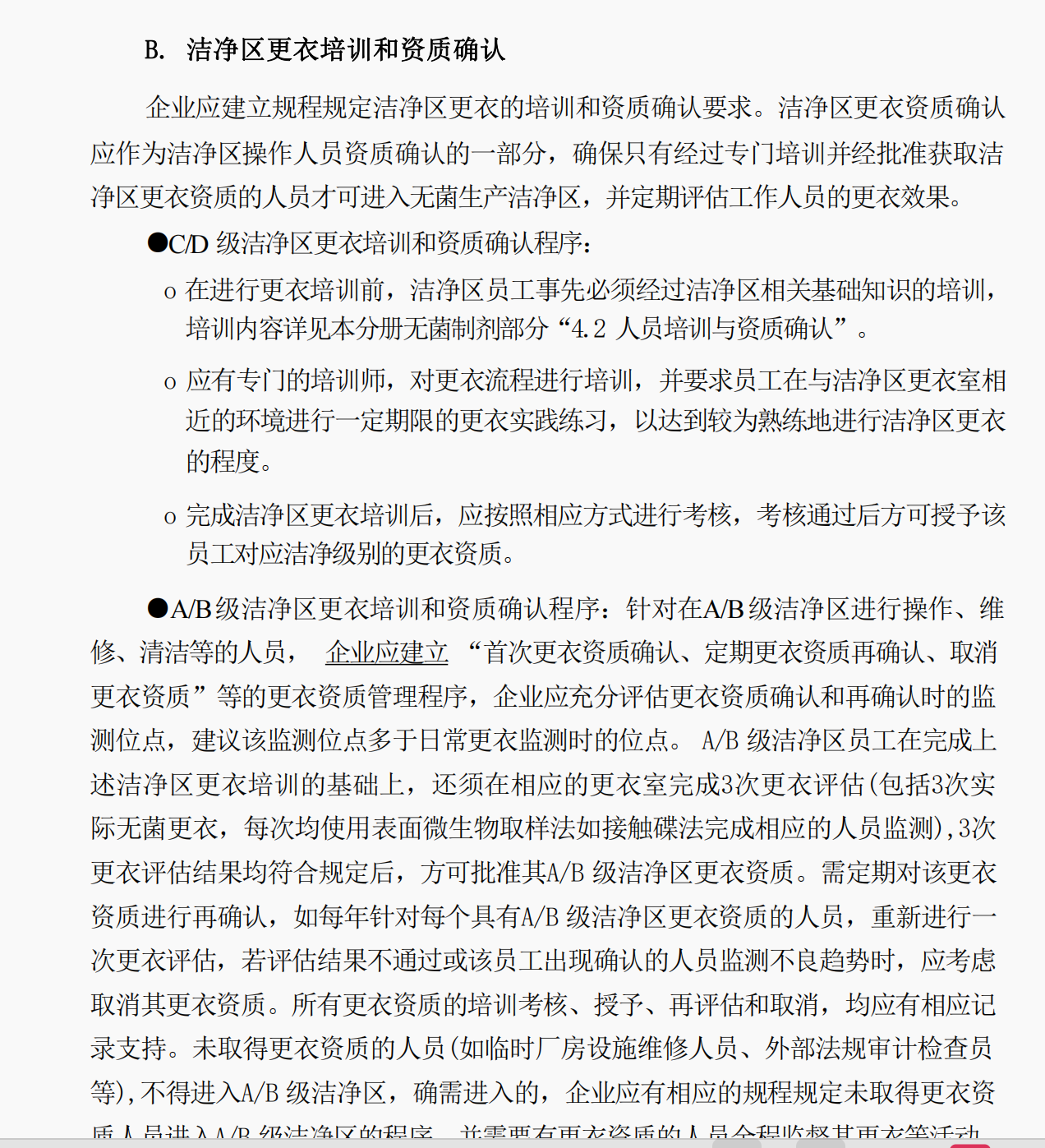
根据欧盟GMP附录1《无菌药品的生产》,更衣确认(Gowning qualification)定义为“以初始和定期的方式确认个人穿戴完整工作服的能力的一个计划”。
如题,若更衣确认指代定期微生物评估等确认手段,C级一般不要求。然而从上述法规关于更衣确认的定义来看,C级也需要更衣确认,只是不同洁净级别的更衣确认和培训水平要求不同。如《药品GMP指南》2023版:
- C/D级洁净区更衣培训和资质确认程序,包括进行更衣培训前,洁净区人员需经过洁净区相关基础知识培训;完成更衣培训,应按照相应方式进行考核,考核通过后方可授予该员工对应洁净级别的更衣资质。
- A/B级洁净区更衣培训和资质确认程序:企业应充分评估更衣资质确认和再确认时的监测位点,建议该监测位点多于日常更衣监测时的位点。A/B级洁净区员工在完成上述洁净区更衣培训的基础上,还需在相应的更衣室完成3次更衣评估(包括3次实际无菌更衣,每次均使用表面微生物取样法如接触碟法完成相应的人员监测),3次更衣评估结果均符合规定后,方可批准其A/B 级洁净区更衣资质......
进入A/B级洁净区的更衣往往是在C级更衣基础上进行,因此C级更衣操作不当可能给B级更衣区域及B级操作区域带来潜在风险,当员工进行B级更衣定期再评估时,若发现微生物评估反复出现不良趋势并可能源于不符合C级更衣程序,该员工需再次进行C级更衣培训和资质再确认。从CCS整体概念来看,C级更衣确认不是独立的单元,而是纳入CCS系统化受控范畴。
需要。
虽然过去的旧版法规主要将严苛的更衣确认(Microbiological assessment)集中在A/B级(无菌核心区),但随着新版 EU GMP Annex 1 的全面实施,以及QRM(质量风险管理)理念的深入,对所有洁净区(包括C级和D级)的人员更衣进行确认已成为明确的合规期望。
主要法规与指南依据:
EU GMP Annex 1 (2022版) 第 7.14 条:
“Personnel entering the cleanrooms should be qualified and assessed for their gowning ability. This qualification should at least include visual assessment and microbiological assessment (monitoring) of the gowning process.”
(进入洁净区的人员应具备相应的资格,并对其更衣能力进行评估。这种确认至少应包括对更衣过程的目视评估和微生物评估(监测)。)
解读:条款使用的是“the cleanrooms”(洁净区),并未将其局限于A/B级。这意味着C/D级人员也必须进行更衣确认,只是确认的频次、标准和取样点与A/B级存在风险等级上的差异。
PDA Technical Report No. 13 (修订版) - 环境监测计划:
也建议基于风险对受控环境(非无菌核心区)的人员进行初始的更衣资质确认,以建立人员卫生和SOP依从性的基线。
中国 NMPA GMP《无菌药品》附录:
第二十四条规定了人员更衣和卫生的通用要求。虽然没有极其死板地规定C级的微生物挑战细节,但在历年的CDE核查和飞检中,检查员越来越倾向于要求企业提供C级人员“已被证明具备正确更衣能力”的客观证据(即更衣确认报告)。
c级区更衣确认和A/B级区更衣确认的区别:
C级的更衣确认,绝对侧重于更衣流程规范性和个人卫生习惯的屏障有效性,而不是盲目追求像B级那样的极限挑战。
这与B级更衣确认有本质的区别:
B级(无菌更衣): 核心是无菌技术。你的手(虽然戴了无菌手套)绝对不能碰到无菌洁净服的外部。它挑战的是在极其别扭的更衣动作下,依然能保持无菌服外部零污染。
C级(微粒与微生物控制更衣): 核心是包裹性和合规性。C级通常使用的是灭菌或经严格清洗的洁净服(不一定要求绝对无菌拆包),其目的是把人体的皮屑、毛发和微生物兜住,不污染C级环境。
因此,C级更衣确认不需要像B级那样进行极其严苛的动作挑战(如剧烈扭动、长时间模拟等),也不需要挑战所谓的“更衣次数极限”。
法规没有强制说C级需要做,都是企业在执行过程中层层加码,但是若是C+A的情况,即C级环境为A级的背景环境,做一下,我是认可的,这种C级与常规的C级,目的不一样。
如果做更衣确认,那都是规范更衣,微生物人员进行全身取样(从头顶到膝盖,其实就是基于风险,这些地方在更衣过程中会大概率被碰到),主要是流程的挑战,至于次数一般都是常规验证,执行3次。
同时现在的欧盟附录1要求高,不止是进行全身取样,在更衣之前和之后,应即时目视检查工作服的清洁度和完整性,以及进入洁净区最长穿戴时间等,这都是欧盟附录1新提的很多关注点。
当然,所有的事情,做了很多之后,需要注意回归根本,我们看下欧盟附录1的原文,针对“更衣确认”的定义,主要强调是“能力”,即:
Gowning qualification – A programme that establishes, both initially and on a periodic basis, the capability of an individual to don the complete gown.
更衣确认(Gowning qualification)- 以初始和定期的方式确定个人穿戴完整工作服的能力的一个计划。
以下是欧盟附录1,关于更衣确认的原文条款:
7.4 The personnel accessing grade A and B areas should be trained for aseptic gowning and aseptic behaviours. Compliance with aseptic gowning procedures should be confirmed by assessment and periodic reassessment at least annually, and should involve both visual and microbial assessment (using monitoring locations such as gloved fingers, forearms, chest and hood (facemask / forehead). See paragraph 9.30 for the expected limits). The unsupervised access to the grade A and grade B areas where aseptic operations are or will be conducted should be restricted to appropriately qualified personnel, who have passed the gowning assessment and have participated in a successful APS.
7.4 进入A级和B级区的人员应接受无菌更衣和无菌行为的培训。应通过评估和至少每年定期再评估来确认符合无菌更衣规程,并应包括目检和微生物评估(使用戴手套的手指、前臂、胸部和头罩(口罩/额头)等监测位置。预期限度参见9.30)。对于正在或即将进行无菌操作的A级和B级区,无监督进入应仅限于经过适当资质确认、已通过更衣评估并参与过成功的APS的人员。
7.11 The clothing and its quality should be appropriate for the process and the grade of the working area. It should be worn in such a way as to protect the product from contamination. When the type of clothing chosen needs to provide the operator protection from the product, it should not compromise the protection of the product from contamination. Garments should be visually checked for cleanliness and integrity immediately prior to and after gowning. Gown integrity should also be checked upon exit. For sterilised garments and eye coverings, particular attention should be taken to ensure they have been subject to the sterilisation process, are within their specified hold time and that the packaging is visually inspected to ensure it is integral before use. Reusable garments (including eye coverings) should be replaced if damage is identified, or at a set frequency that is determined during qualification studies. The qualification of garments should consider any necessary garment testing requirements, including damage to garments that may not be identified by visual inspection alone.
7.11 工作服及其质量应适合于工艺和工作区的级别。应以保护产品免受污染的方式穿戴工作服。当选择的工作服类型需要为操作工提供保护时,不应损害防止产品污染的保护。在更衣之前和之后,应即时目视检查工作服的清洁度和完整性。离开洁净室后也应立刻检查工作服的完整性。对于已灭菌的工作服和护目镜,应特别注意确保它们已经过灭菌处理、在规定的放置时间内、并且已目视检查包装确保在使用前是完整的。可重复使用的工作服(包括护目镜)应在发现破损时更换或以确认研究中确定的频率更换。工作服的确认应考虑任何必要的工作服测试要求,包括仅通过目视检查可能无法发现的工作服破损。
7.14 Cleanroom gowning should be performed in change rooms of an appropriate cleanliness grade to ensure gown cleanliness is maintained. Outdoor clothing including socks (other than personal underwear) should not be brought into changing rooms leading directly to grade B and C areas. Single or two-piece facility trouser suits, covering the full length of the arms and the legs, and facility socks covering the feet, should be worn before entry to change rooms for grades B and C. Facility suits and socks should not present a risk of contamination to the gowning area or processes.
7.14 洁净室更衣应在适当洁净级别的更衣室进行,以确保维持工作服的洁净度。不得将包括袜子在内的便服(个人内衣除外)带入直接通往B级和C级区的更衣室。在进入B级和C级的更衣室之前,应穿着覆盖整个手臂和腿部的连体服或衣裤分开的工作服,以及覆盖脚部的工作袜子。工作服和袜子不应对更衣区或者工艺带来污染风险。
7.15 Every operator entering grade B or A areas should gown into clean, sterilised protective garments (including eye coverings and masks) of an appropriate size at each entry. The maximum period for which the sterilised gown may be worn before replacement during a shift should be defined as part of the garment qualification.
7.15 每位操作工在每次进入B级或A级区时,都应更换合适尺寸的经灭菌的洁净防护服(包括眼罩和面罩)。应定义轮班期间更换前经灭菌的工作服的最长穿戴时间,作为工作服确认的一部分。
这{{threadTextType}}正{{isAdminText}}
为帮助审核人员更快处理,请填写举报原因:
为帮助审核人员更快处理,请填写举报原因: